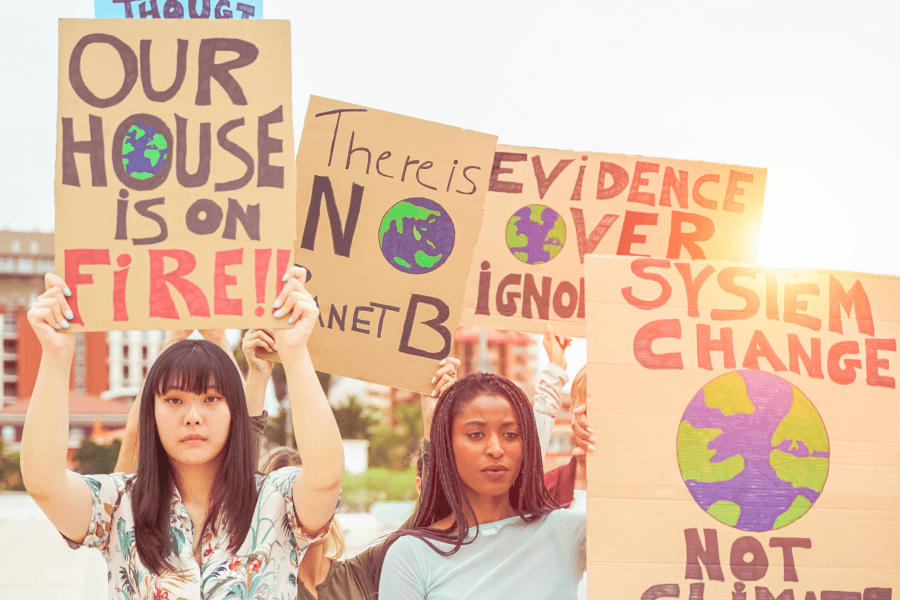
An insightful study by Pew Research Center last fall showed a high percentage of Americans believe climate change will have a negative impact on the places where they live and work. When it comes to the personal impact of climate change, most Americans believe they will have to make at least minor sacrifices over their lifetimes because of climate change. Pew Research Center (October 2023)
Most young adults between the ages of 18 to 29 foresee worsening climate impacts: 78% think harm to people in the U.S. caused by climate change will get a little or a lot worse in their lifetime. Among Republicans, those aged 18 to 29 are, “25 points more likely than those aged 65 and older to say human activity contributes a great deal to climate change (35% vs. 10%). By comparison, similar majorities of both younger and older Democrats say human activity contributes a great deal to climate change.”
What does this mean for Citizens’ Climate Lobby? We need to enlist more young people as volunteers and advocates in our work, but also, we need to do a better job of convincing people of all ages and political persuasions that climate change is a real threat. We have work to do.
An important finding of the Pew Research report that is key to Citizens’ Climate Lobby is, “when it comes to the federal government, 47% think it can help a lot to reduce the effects of climate change; 40% say this about cities and communities.”
This is where Citizens’ Climate Lobby excels. Our organization empowers people of all ages and political persuations to work together on climate policy. Our supporters are organized into more than 400 chapters across the United States – including the Austin Metro Chapter – building support in Congress for a national bipartisan solution to climate change.
In order to pass climate policy, Congress must hear a chorus of many different voices. Citizens’ Climate Lobby works with members of Congress across the political spectrum to find common ground on climate change action.
How can you help? Join our chapter. Our secure conversation platform managed by the national office makes it easy to learn about climate change and key action items online, at your own convenience. Monthly meetings and occasional social events are held during the year, as are “tabling” events throughout the community (volunteers welcome). This coming June, consider attending the June Conference and Lobby Day in Washington, D.C.: June 8 – 11, 2024 at the Omni Shoreham Hotel.
Texas in particular is at risk because of global warming. The EPA notes in its 2016 report, “What Climate Change Means for Texas”:
Texas’s climate is changing. Most of the state has warmed between one-half and one degree (F) in the past century. In the eastern two-thirds of the state, average annual rainfall is increasing, yet the soil is becoming drier. Rainstorms are becoming more intense, and floods are becoming more severe. Along much of the coast, the sea is rising almost two inches per decade. In the coming decades, storms are likely to become more severe, deserts may expand, and summers are likely to become increasingly hot and dry, creating problems for agriculture and possibly human health.
It is our hope that responsible business and elected leaders from all political viewpoints will realize climate change has – and will continue to have – a significant impact on the ever growing population of Texas. And not all of that impact will be positive. There are many things that can be done to better prepare our state and its citizens, including creating and adjusting policies at the local, state and national levels.
If you fall into the above leadership categories, reach out to Citizens’ Climate Lobby for assistance with timely, factual information. We are on point at your convenience and that of your staff members, and as always, we are nonpartisan in our approach.
To reach our Chapter, the following are available to assist, or use the secure contact form on this website to reach us. Thank you!
Media – Kalpana Sutaria: kalpana.sutaria@usa.net
Lobbying – Bruce Miglin: bmiglin@comcast.net
Group Organization and Development – Cynthia Lesky: cynthia.lesky@gmail.com
Grassroots (tabling) – Jessy Eubanks: jessyeubanks@gmail.com
Constitution of the United States
Written in 1787, ratified in 1788 … the United States Constitution is the world’s longest surviving written charter of government. Its first three words – “We The People” – affirm that the government of the United States exists to serve its citizens. The supremacy of the people through their elected representatives is recognized in Article I, which creates a Congress consisting of a Senate and a House of Representatives. The positioning of Congress at the beginning of the Constitution affirms its status as the “First Branch” of the federal government.
 Voices of Austin @CCLATX