
Texas Legislature

Why Congress Can’t Pull the Plug on Texas’ Clean Energy Progress

On May 22, the House of Representatives voted to pass a budget bill that drastically cuts America’s clean energy tax credits. I’m disappointed to see that the House advanced this legislation.

Make no mistake: These cuts will hurt Texas if they go on to become law. Experts are already warning that these changes would raise energy costs for American households, increase pollution, and threaten growing economic investments we’ve seen in Texas. The House passage of this bill just put these investments at risk.

These federal tax credits—designed to boost clean energy manufacturing in the U.S. – have been working, just as decades of tax-related supports have helped oil and gas. Since the passage of the Inflation Reduction Act (IRA) in 2022, Texas has benefited from nearly $8 billion invested in 29 projects leading to over 10,000 new jobs from clean energy projects. Besides our strengths in oil and gas production, Texas can continue to be the leader among states in clean energy deployments. But by some estimates killing these tax credits will jeopardize as many as 122,000 jobs and up to $130 billion in private investments in Texas.

The need for power – and clean power in particular – is almost infinite in the face of future demand from high-consumption applications like datacenters and water purification. Why not continue to unleash our state’s huge potential for sun, wind, and geothermal?

The tax credits were passed by Democrats, so they have been an easy target for Republican attacks. But nationwide the legislation has overwhelmingly benefited Republican-held districts – 78% of the funding has gone to rural and suburban areas held by the GOP. That includes Texas, where manufacturers like Samsung C&T Renewables, General Electric and many, many smaller companies announced major investments thanks to these tax credits.

But that success story could unravel quickly. The legislation is now in the Senate’s hands, and the House passage has set them on a path toward drastic cuts.

If the cuts become law, energy prices will rise. Rolling back these tax credits means Texas ratepayers will face higher electricity prices in coming years.

By contrast, if Congress protects clean energy tax credits, it would boost Texas’ economy over the next decade, helping meet the challenges of a growing population and growing high-energy demand industries. Clean energy projects can even help stabilize our water supply in the Permian basin where oil and gas production requires huge amounts of water that can be reused if enough energy is applied to clean it up.

Encouragingly, some Republican members of Congress are vocalizing their support for the clean energy tax credits. Four Republican Senators sent a letter to leadership last month saying that repeal would “lead to significant disruptions for the American people and weaken our position as a global energy leader.”

The numbers are clear: clean energy tax credits are working for Texas. Undoing clean energy tax credits now – as the House just voted to do – would be reckless and harmful. I urge Senators Cornyn and Cruz to work with their colleagues in the Senate to protect these tax credits.

Cynthia Lesky, Group Development and Organization for Citizens’ Climate Lobby Austin, Texas

Letter submitted to the Austin American-Statesman

May 25, 2025


From the Citizens’ Climate Lobby secure conversation platform, Austin Chapter:

I’ve been a member of CCL since the fall of 2017. I joined shortly after moving to Austin from Highland Park, IL. For the last 30 years I’ve devoted most of my energies to my family and to a small business I built serving the needs of corporate information centers (I’m a librarian by training.) When I finally had the time to give back a little bit, I went searching for ways to get involved in climate change activism and also to meet people in my new community.

The laser focus on carbon pricing and the genuinely big-hearted, bipartisan, respectful culture of CCL were the big draws for me. I’ve been growing steadily more active as I find my strengths intersect with the various needs of the organization and of the cause. My involvement with Citizens’ Climate Lobby has been an affirming, learning experience for me, a source of new friends, and an avenue for personal growth.

Texas turning green? Homeowners embrace solar panels, aiming to slash electric bills

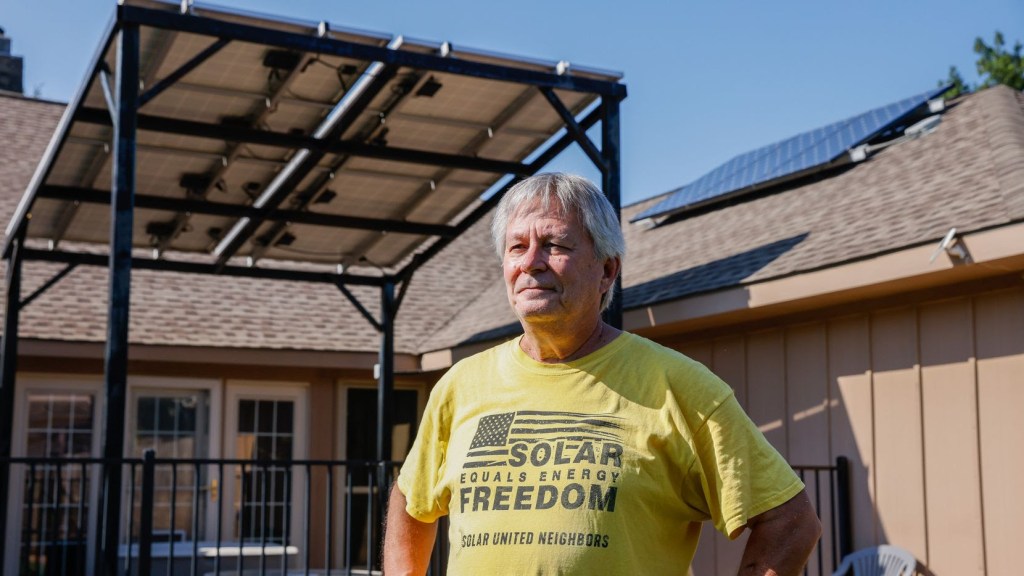
A decade ago, Larry Howe was drawn to solar energy and became an early adopter. He put solar panels on the roof of his Plano home in 2012 and, a few years later, added solar panels above his backyard patio to provide shade and power.

“We use the most air conditioning in the summer when the sun is shining,” he said. “So I thought: ‘Why not take advantage of generating some of that electricity right when I need it?’”

Similar ideas have won over millions of homeowners across the country.

The U.S. hit 1 million residential solar installations in 2016 and reached 2 million in 2019. By the end of June 2022, roughly 3.5 million residential solar installations were in place nationwide, according to a report by the Solar Energy Industries Association and research firm Wood Mackenzie.

More growth lies ahead. Last month, Congress approved a climate law that increases the tax credit on rooftop solar to 30% and remains in place for a decade. Texas’ residential solar capacity will grow five-fold by 2027, in part because of the tax break, the solar energy association said.

Many homeowners choose solar because of concerns about climate change and extreme weather. They want to reduce their carbon footprint and embrace clean energy.

Others want to cut their electric bills, and solar’s cost-benefit proposition has never been better. Electricity rates surged in the past year while the cost of solar panels has fallen sharply over the past decade. That combination shortens the payback period from investing in solar.

Texans have additional reasons to consider solar. After a 2021 winter storm shut down the grid for days and killed hundreds, some want to become more self-reliant and lighten the load on the grid.

When Howe first added solar panels, he knew just about every house that had them in his neighborhood.

“Now, every time I drive around Plano, I think: ‘I don’t remember that one,’” he said. “They’ve become almost commonplace, and that’s a great thing.”

Howe, who co-founded the volunteer group Plano Solar Advocates, has been tracking the number of rooftop installations statewide since 2014. He includes businesses such as big-box stores, but residential homes account for the vast majority.

Texas had over 160,000 rooftop solar projects in the fourth quarter of last year — more than double the number in 2019, according to data from Howe and the Texas Solar Energy Society.

Utility-scale solar, created by power providers in Texas’ deregulated market, accounts for the vast majority of solar generation here. Texas ranks low among states for the share of solar from residential, a metric that shows much room for growth.

“Small-scale solar” projects, as they’re often called, are coming on strong. They generated over 2.2 million megawatt hours of electricity in Texas last year, up from 1 million megawatt hours two years earlier, according to data from the U.S. Energy Information Administration.

The average value of solar panel shipments — a proxy for price used by the government — dropped nearly 83% from 2010 to 2021. That included an 11% decline last year despite supply chain constraints and higher material costs, the agency said.

Howe said he spent about $10,000 in out-of-pocket costs for his system, which totals 4.5 kilowatts. It generates about 60% of his electricity use annually and saves him roughly $100 a month on his electric bill.

In general, he said, homeowners can recoup their upfront solar investments in about 10 years. His payback period will be closer to 12 to 14 years because the cost was higher a decade ago and electricity rates were lower.

Howe helped create early solar co-ops that brought together local residents and leveraged their buying power for rooftop projects, and that approach continues. On Tuesday, the 2022 version of the Plano solar co-op was launched with the help of the nonprofit Solar United Neighbors.

“A lot of our work is to bring people together around their shared interests in learning about solar and the costs of installation,” said Hanna Mitchell, director of the group’s Texas program. “The co-ops are a large portion of that.”

By Wednesday, 30 people had signed on to learn more about solar panels and discounts from bulk buying. The goal is to attract 150 members by the end of November.

The co-op’s webpage is at solarunitedneighbors.org/plano, and information sessions are offered on Sept. 22 and Sept. 29.

Members will exchange information and evaluate vendors, eventually selecting a contractor to do installations for the group. In Plano, the average solar panel array is 8 kilowatts, capable of generating about 12,000 kilowatt hours of electricity a year, Mitchell said.

The average cost is about $20,000, including the co-op discount and before the federal tax credit. Co-op members typically get a discount of 10% to 20%, Mitchell said, and they’re under no obligation to buy panels or use the selected vendor.

“It’s a great way to inform yourself about solar, and the vendors have to be really transparent,” said Raul Lozano, a Plano homeowner since 2015. “And you’re probably going to get the best deal.”

Lozano was a member of last year’s Plano solar co-op, and he bought a 17-kilowatt system, much larger than average, for his 2,700-square-foot house. He said he paid about $32,000 before the tax credit and has been generating about 88% of his electricity in 2022.

“It’s over-performing,” Lozano said. “In some months, I wasn’t paying anything.”

That isn’t necessarily ideal because the value of excess generation is limited in Texas. The state does not require net metering, which pays homeowners the full cost of electricity when they pump excess power into the grid.

Most states, along with some large municipal utilities in Texas, have net metering policies that reward bigger generators.

While Lozano expects to recover his costs in about eight years, he said he can’t take full advantage of his system’s size.

“Whatever extra I produce is probably going to my neighbor’s home and the retailer is charging them,” Lozano said. “But I’m not getting paid.”

That leads to some unorthodox approaches to energy use. During the day, when demand is highest and Texas grid operators sometimes ask residents to cut back on power, both Lozano and Howe recharge their electric vehicles and run washers, dryers and dishwashers.

That’s because they may be generating more solar power than they’re using. And if they wait to charge the EVs at night, they must pay a higher retail rate.

At least 38 states have mandatory net metering rules, according to the Solar Energy Industries Association. Net metering strengthens the financial case for adding panels, but Mitchell said Texas lawmakers don’t like the idea.

“There’s more support for letting the market take care of it,” she said.

Larry Howe by Lola Gomez.
Larry Howe has been an outstanding volunteer with Citizens’ Climate Lobby. We wanted to share this information article and thank him for his leadership. This photo is by Lola Gomez and a link to the full article is below.

Mitchell Schnurman, Dallas

The Dallas Morning News

September 8, 2022